Abel, P., Hornung, J.J., Kear, B.P. & Sachs, S. (2019) Reassessment of the enigmatic pterosaur ‘Ornithocheirus’ wiedenrothi from the Lower Cretaceous of northern Germany. Starck, M. & Huysseune, A. (eds) International Congress of Vertebrate Morphology (ICVM) Abstract Issue 2019. Journal of Morphology, Supplement 280: S73-S74.
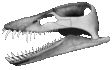
—In stark contrast to the famously rich Jurassic fossil record, the documented occurrences of Cretaceous pterosaur remains from Germany are extremeley sparse. To date, only a few bones and footprint traces have been found in strata of Berriaisian–Hauterivian age. The most complete and best-preserved of these specimens is the holotype of ‘Ornithocheirus’ wiedenrothi from the lowermost Hauterivian (Endemoceras amblygonium Zone) Stadthagen Formation of Engelbostel, near Hanover in Lower Saxony, northern Germany. This fragmentary skeleton comprises parts of the mandible, including a long symphyseal rostrum, some forelimb elements, and a section of a dorsal rib. The mandible displays several distinctive features, most notably, an anteriorly directed spur-like process at the tip of the mandibular symphysis, and an enlarged and anterodorsally inclined pair of teeth at the first tooth position in the jaw (these are also bordered by a prominent sulcus). When first described in 1990, ‘O.’ wiedenrothi was assigned to Ornithocheirus based on similarities with ‘Ornithocheirus’ compressirostris, which was then classified as the type species of the genus. However, ‘O.’ compressirostris has since been referred to Lonchodectes, which resembles ‘O.’ wiedenrothi in its lanceolate mandibular rostrum, and oval alveolar profile with raised alveolar ridges. ‘Ornithocheirus’ wiedenrothi is not directly comparable with the likely monotypic Ornithocheirus sensu stricto as no equivalent mandibular elements have been recovered for the type species O. simus. Consequently, while we concur with lonchodectid affinity, we consider ‘O.’ wiedenrothi to possibly represent a separate genus, and thus a novel addition to the Early Cretaceous pterosaur diversity of Europe.