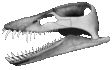
Sachs, S., Lindgren J. & Kear, B.P. (2018) Reassessment of the Styxosaurus snowii (Williston, 1890) holotype specimen and its implications for elasmosaurid plesiosaurian interrelationships. Alcheringa 42(4): 560-574.
—The holotype (KUVP 1301) of Styxosaurus snowii—one of the earliest described elasmosaurid plesiosaurians—consists of a well-preserved cranium, mandible and articulated sequence of anterior–mid-series cervical vertebrae found in the lowermost Campanian strata of the Smoky Hill Chalk Member in the Niobrara Formation of Kansas, USA. This particular specimen has proven important for recent phylogenies of Elasmosauridae, and is integral to resulting definitions of the subfamily-level clade, Styxosaurinae. Despite this, KUVP 1301 has not been redescribed or figured in detail since its original taxonomic establishment. We, therefore, re-evaluated KUVP 1301 and assessed its phylogenetic implications. Several notable character states are pertinent for diagnosing S. snowii at genus and species level: (1) an anisodont functional dentition comprising enlarged premaxillary and dentary teeth with a pair of maxillary ‘fangs’, and elongate posterior-most dentary teeth that overlap the upper tooth row; (2) a prominent dorsomedian crest extending from the tip of the premaxillary rostrum, and expanding into a low ‘mound-like’ boss between the external bony nasal openings and orbits; (3) a pronounced convex projection on the posterolateral edge of the squamosals; and (4) platycoelous post-axial cervical vertebral centra that are substantially longer than high, and bear both lateral longitudinal ridges and ventral notches. Character state comparisons with the congeneric subfamily specifier Styxosaurus browni suggest that taxonomic distinction is possible, but equivocal. We, therefore, restrict our definition of Styxosaurus to morphologies observable in KUVP 1301. Furthermore, phylogenetic analysis of our first-hand data returns inconsistent elasmosaurid intra-clade relationships, especially with regard to Styxosaurinae. Consequently, we posit that a more targeted reassessment of Elasmosauridae is necessary to resolve both species-level topologies and higher taxonomy within the group.