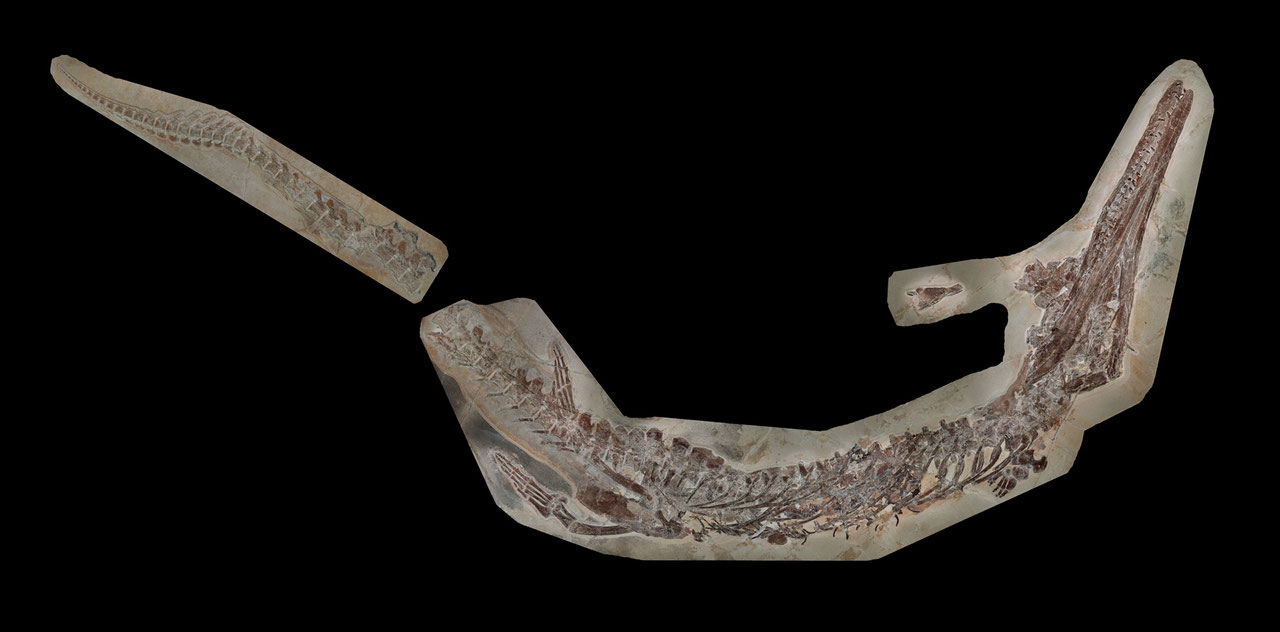
Cricosaurus bambergensis skeleton on a black background

Cricosaurus bambergensis, a marine crocodile from the Late Jurassic of Germany

by Sven Sachs, Mark T. Young, Pascal Abel & Heinrich Mallison

The Naturkunde-Museum Bamberg undertakes regular excavations in a limestone quarry near Wattendorf in the district of Bamberg (Bavaria, southern Germany). This quarry exposes lithographic limestones from the Upper Jurassic, very similar to the famous limestone strata of Solnhofen that are known for iconic fossils such as the dinosaurs Archaeopteryx lithographica and Compsognathus longipes and numerous well preserved pterosaur finds.

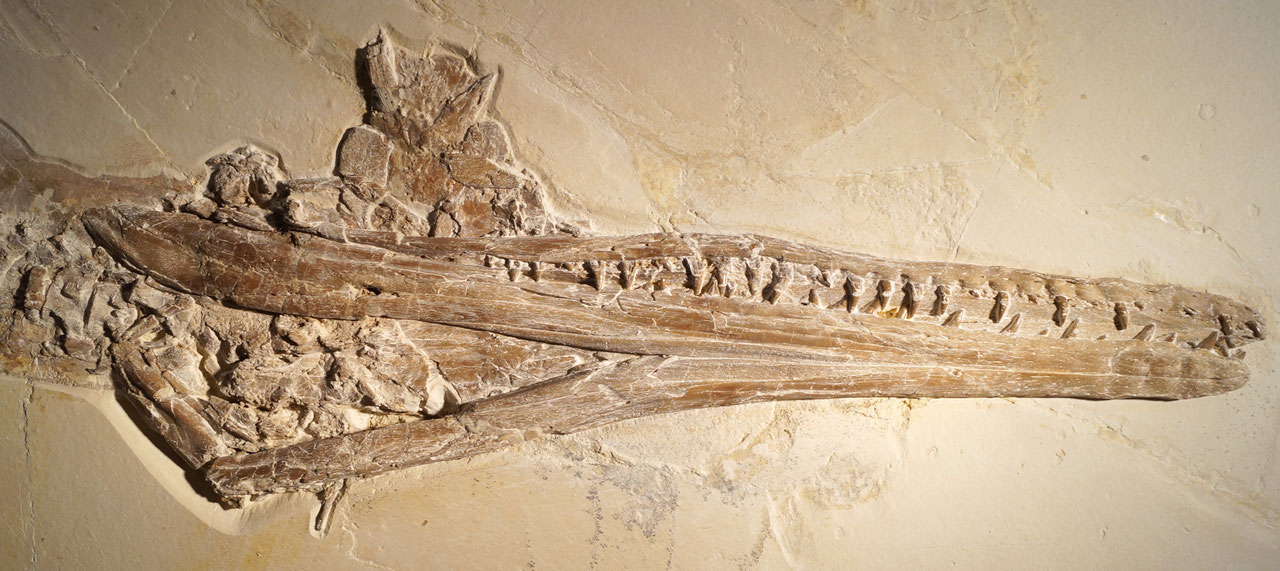
Skull and mandible of Cricosaurus bambergensis in ventral view

Comparable to the limestones from Solnhofen those from Wattendorf were deposited as part of a large lagoon that might have been similar to the recent Bahamas. On the 5th of June 2014, the team of the Naturkunde-Museum Bamberg discovered an entire skeleton of a crocodile with an apparently chopped off tail. The specimen was transferred to the museum’s building where it was prepared and later presented as part of the exhibition of the Wattendorf lagoon (Mäuser, 2014). 

Study by Sven Sachs, Mark T. Young, Pascal Abel and Heinrich Mallison

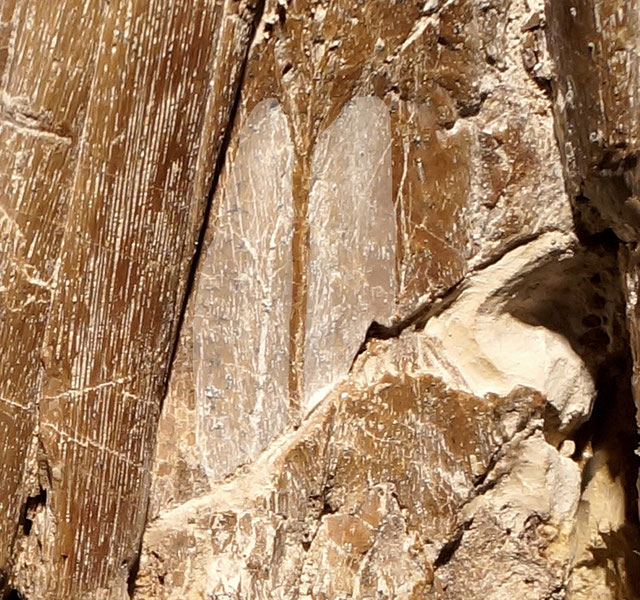
In 2017, a team around Sven Sachs from the Naturkunde-Museum Bielefeld studied the find from Wattendorf. It became clear that the specimen represents a species of Cricosaurus, a marine crocodyliform of the family Metriorhynchidae that was previously known from other localities in southern Germany, but that had also been found in Mexico and Argentina (Frey et al., 2002; Young & Andrade, 2009; Herrera et al., 2013). Our detailed investigation revealed that the Bamberg specimen shows anatomical features which were not yet described from any other fossil marine crocodile. This included a peculiar structure of the palate where two depressions are formed which are separated by a keel. What these depressions were good for is not yet known to us. The tail of the new Cricosaurus also revealed some unique characters. The study of the Wattendorf specimen by Sachs, Young, Abel & Mallison was published on April 4th, 2019 in the journal Acta Palaeontologica Polonica (Sachs et al., 2019).

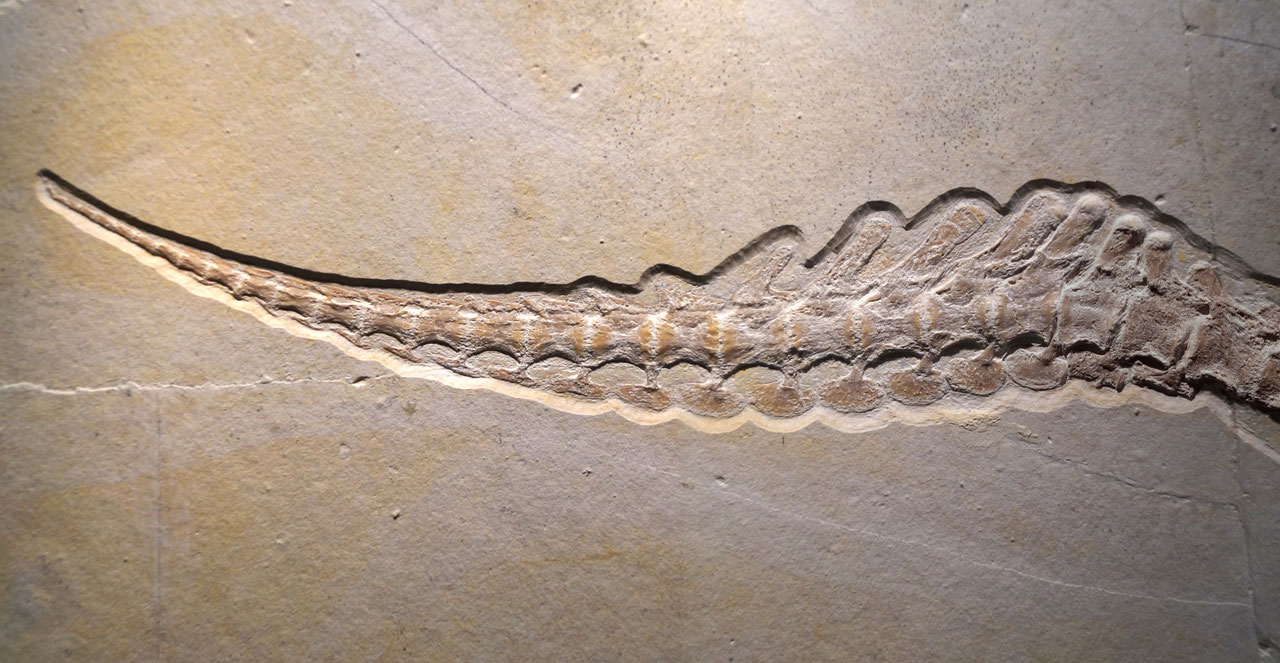
The tail has a mosaic of characters seen in other metriorhynchids. In Metriorhynchoidea there are numerous osteological adaptations to a pelagic lifestyle, one of the most noticeable is the hypocercal tail. The first evidence for a tail bend is known from the late Toarcian, with Magyarosuchus fitosi, a form with a tail bend and full set of osteoderms (Ösi et al., 2018). However, in Metriorhynchidae itself all known forms have a well-developed hypocercal tail and lack osteoderms (Fraas, 1902; Andrews, 1913; Young et al., 2010). Cricosaurus bambergensis is interesting, as it fills a morphological gap between basal metriorhynchids (such as Metriorhynchus superciliosus) and species with longer and sharper tail bends (such as Cricosaurus suevicus, see below). 
Close-up of the palate of Cricosaurus bambergensis, showing the paired depressions
Close-up of the palate of Cricosaurus bambergensis, showing the paired depressions (enhanced)
Articulated tail fluke of Cricosaurus bambergensis

Comparison to other species of Cricosaurus from southern Germany

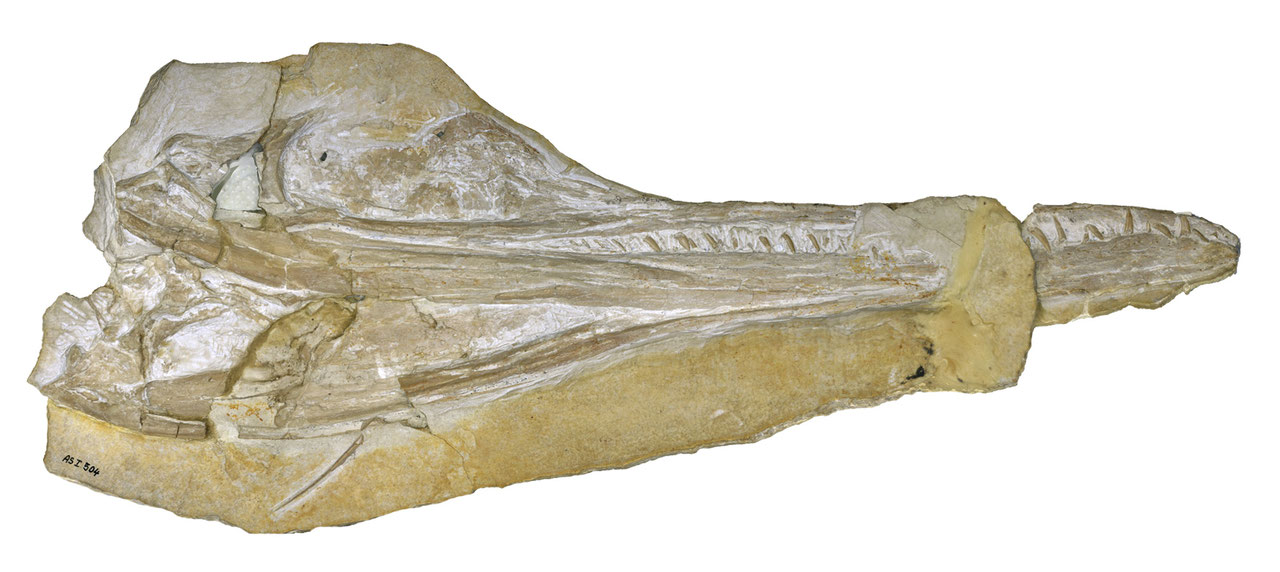
The phylogenetic analysis that shows where the new find is placed in the tree of life, revealed a close relationship to two other Cricosaurus species from southern Germany, Cricosaurus elegans from the Solnhofen limestone deposits and Cricosaurus suevicus from Nusplingen in southwestern Germany. Both species, however, show clear differences to the Wattendorf find, both in the shape of the palate that is distinct in Cricosaurus elegans, and in the shape of the tail fluke that is different in Cricosaurus suevicus (see below).

Skull of Cricosaurus elegans (BSPG AS I 504) in ventral view. Collection of the Bayerische Staatssammlung für Paläontologie und Geologie in Munich (Germany)

The unique characters of the Wattendorf specimen enabled us to describe it as a new species. We decided to name this species after the City of Bamberg, because the specimen was found by the crew of and is on display at Bamberg’s Natural History Museum, and because the locality at Wattendorf is within the district of Bamberg (Sachs et al., 2019).

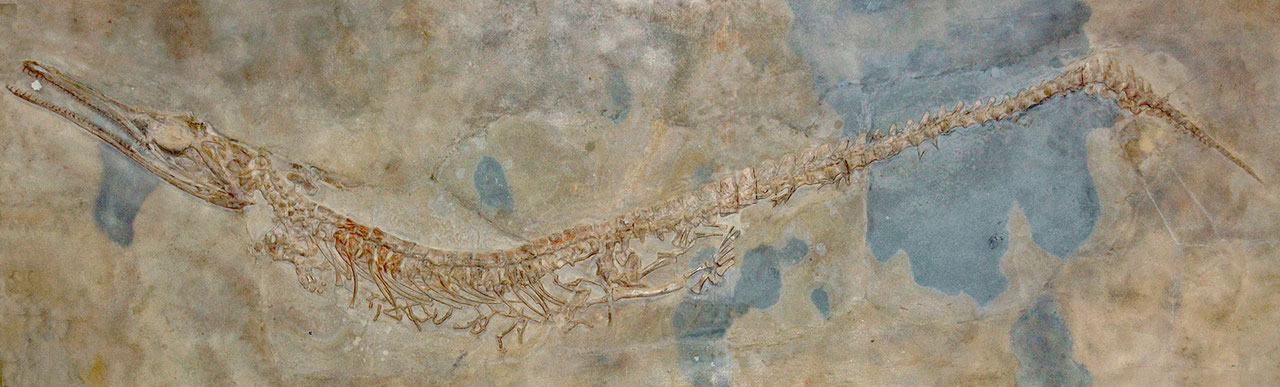
Cricosaurus suevicus (SMNS 9808) aus Nusplingen im Staatliches Museum für Naturkunde in Stuttgart
Lectotype skeleton of Cricosaurus suevicus (SMNS 9808) at the Staatliches Museum für Naturkunde in Stuttgart (Germany)

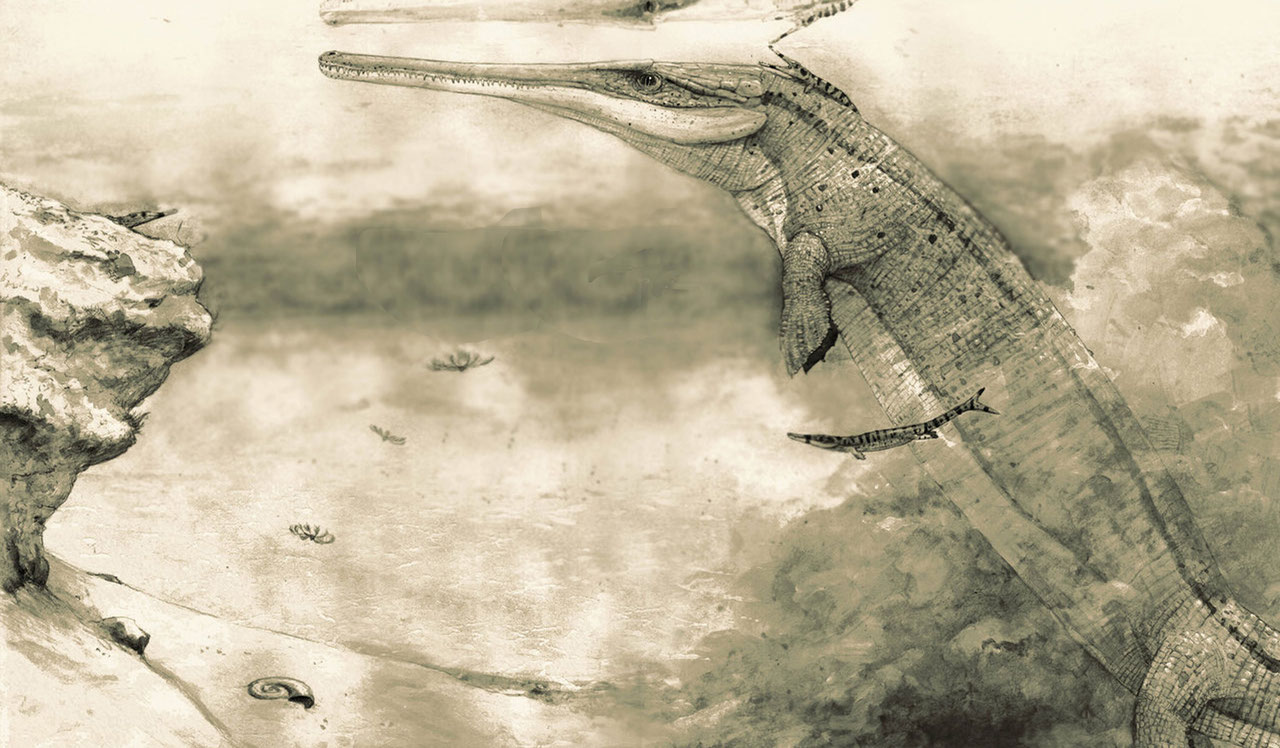
The genus Cricosaurus comprises rather small and slender metriorhynchids, which likely preyed on fast-moving animals like squids and fish as evident by the small teeth and preserved belemnite rostra in the abdominal region of a specimen from Nusplingen. Besides a high diversity of fish, Cricosaurus bambergensis shared its environment also with different turtles, pleurosaurs, and other marine crocodiles like the large-bodied genera Dakosaurus and Geosaurus. Such a case of “niche partioning” of related species coexisting in the same environment due to a different lifestyle was also already reported for marine crocodiles from the Solnhofen lagoons (e.g. Wagner, 1858; Fraas, 1902; Frickinger, 1994; Young & Andrade, 2009; Andrade et al., 2010). In summary, Cricosaurus bambergensis is an interesting and important addition to both the family Metriorhynchidae and the ecosystem of the Wattendorf lagoon. 

3D data of the Cricosaurus bambergensis holotype

In order to make access to the specimen, which is on show behind a protective glass pane, easier for researchers, we created a very high resolution 3D model. This model is available via the Naturkunde-Museum Bielefeld (email contact).

Life reconstruction of Cricosaurus by Joschua Knüppe

Citations

Mäuser, M. (2014) Frankenland am Jurastrand. Pfeil Verlag, München, 60 pp.

Scroll to Top