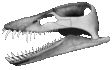
Young, M.T., Ceballos Izquierdo, Y., Orihuela, J., Young, M. T., Sachs, S., Aranda, E., & Viñola-López, L. W. (2025) What is ‘Ichthyosaurus’ torrei? Remarks on the lost holotype of a Cuban marine reptile. Historical Biology, 1-15.
—The Jagua Formation (Oxfordian, Late Jurassic) of western Cuba preserves a diverse marine vertebrate assemblage, including ichthyosaurs and metriorhynchid crocodylomorphs. Among these, the taxonomic placement of ‘Ichthyosaurus’ torrei remains unresolved. The holotype and only specimen (MNHNCu P 3001), a fragmentary skull and mandible, was initially assigned to Ichthyosauridae based on its conical dentition but has since been reinterpreted as a metriorhynchid or indeterminate Jurassic reptile. The specimen, formerly housed at the Museo Nacional de Historia Natural de Cuba (MNHNCu), is now lost, limiting reassessment to photographs, CT scans, and original descriptions. Here, we redescribe the specimen based on the available data and provide the first comprehensive reassessment since its loss. MNHNCu P 3001 is an incomplete cranium with a sub-circular orbit, anteroposteriorly elongated external naris, and conical, unserrated teeth. The preserved morphology has features not seen in metriorhynchids such as paired frontals, extreme elongation of the premaxilla and external nares retracted close to the orbits. Similarly, plesiosaurian diagnostic characters are absent. While its fragmentary nature precludes definitive classification, available evidence supports an ichthyosaurian affinity. This study underscores the significance of the Jagua Formation in revealing the diversity of Jurassic marine reptiles in the Proto-Caribbean region.