Sachs, S. & Kear, B.P. (2015) Fossil Focus: Elasmosaurs. Palaeontology Online, Volume 5, Article 2: 1-8.
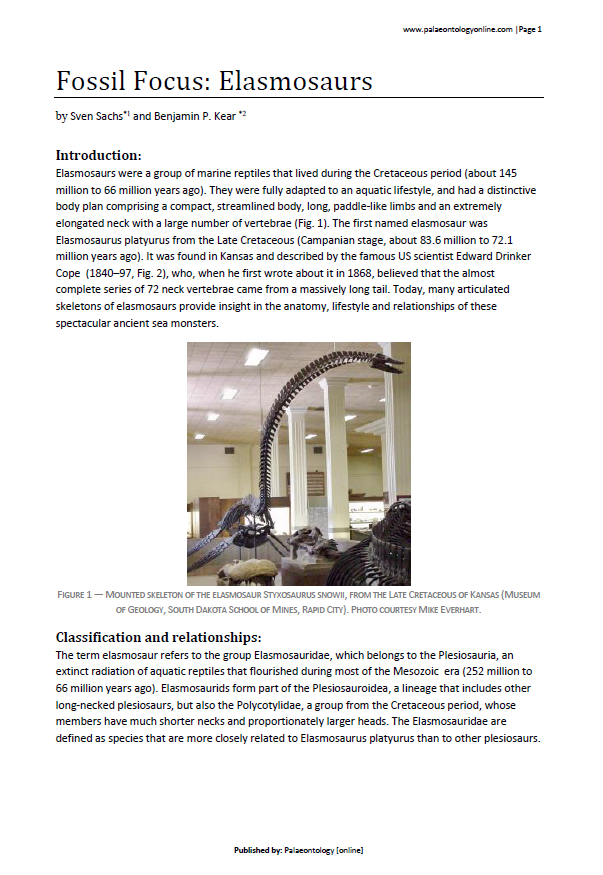
—Elasmosaurs were a group of marine reptiles that lived during the Cretaceous period (about 145 million to 66 million years ago). They were fully adapted to an aquatic lifestyle, and had a distinctive body plan comprising a compact, streamlined body, long, paddle-like limbs and an extremely elongated neck with a large number of vertebrae (Fig. 1). The first named elasmosaur was Elasmosaurus platyurus from the Late Cretaceous (Campanian stage, about 83.6 million to 72.1 million years ago). It was found in Kansas and described by the famous US scientist Edward Drinker Cope (1840–97, Fig. 2), who, when he first wrote about it in 1868, believed that the almost complete series of 72 neck vertebrae came from a massively long tail. Today, many articulated skeletons of elasmosaurs provide insight in the anatomy, lifestyle and relationships of these spectacular ancient sea monsters.