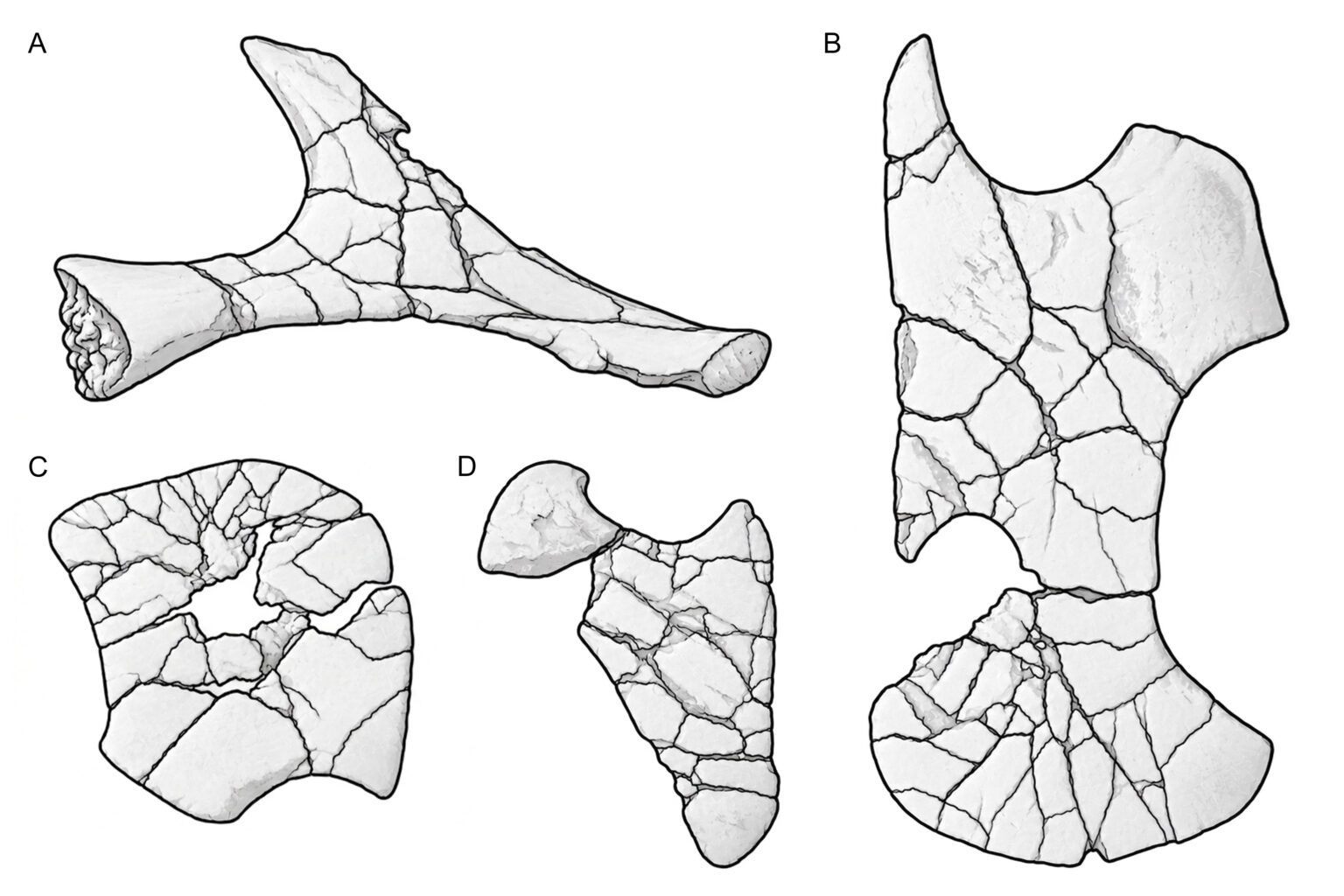
Chubutinectes carmeloi represents a non-aristonectine elasmosaurid and is among the stratigraphically youngest known plesiosaurs, originating from the late Maastrichtian (Upper Cretaceous) La Colonia Formation. The holotype and only known specimen, MPEF-PV 5232, consists of an incomplete postcranial skeleton discovered in 2021 by a team from the Museo Paleontológico Egidio Feruglio near the Somún Curá Plateau, in northern Chubut Province, Argentina. The specimen was found disarticulated and comprises most of the vertebral column, together with elements of the pectoral and pelvic girdles and partial limbs. The skull and most of the cervical vertebrae, however, are missing.
O’Gorman et al. (2023) described MPEF-PV 5232 as a new genus and species, Chubutinectes carmeloi, and noted that the specimen represents an osteologically immature individual (sensu Araújo et al. 2015). This is indicated by the lack of fusion between the neural arches and centra, as well as between the cervical ribs and their respective vertebrae. It should be noted, however, that some characters included in the diagnosis, particularly those relating to the appendicular skeleton, such as the reduction of the cornua of the coracoid and pubis, the coracoid-to-scapula length ratio, and the shape of the spatium interosseum (epipodial foramen), have been suggested to vary during ontogeny (e.g. Brown 1981, Carpenter 1999, Sachs & Madzia 2025).
Genus Chubutinectes O'Gorman, Carignano, Calvo-Marcilese & Pérez Panera, 2023
Type species: Chubutinectes carmeloi O’Gorman, Carignano, Calvo-Marcilese & Pérez Panera, 2023
Distribution: Late Cretaceous, Maastrichtian, South America (Argentina).
Chubutinectes carmeloi O’Gorman, Carignano, Calvo-Marcilese & Pérez Panera, 2023
Holotype: MPEF-PV 5232, incomplete postcranial skeleton.
Stratum typicum: La Colonia Formation, late Maastrichtian, Late Cretaceous.
Locus typicus: Puesto Los Colorados, Somún Curá plateau, Chubut, Argentina.
Diagnosis: Elasmosaurid characterised by this combination of characters: middle cervical centra longer than their height, bearing a lateral keel and bilobate articular surfaces; a minimum of twenty-two dorsal vertebrae; approximately 24 or more caudal centra; bilobate articular surfaces on the posterior cervical, pectoral, and anterior dorsal centra; coracoids bearing a closed, heart-shaped pectoral fenestra and an elongated anterior process; a high coracoid-to-scapula length ratio; an ilium with an angularly deflected shaft; pubis bearing small lateral cornua; a humerus with posterior expansion terminating in an accessory facet; humeral epipodial facets positioned almost in alignment; epipodial elements wider than long; a short, elliptical epipodial foramen; and accessory ossifications situated between the tibia and tibial element, and between the radius and radial element (slightly modified from O’Gorman et al. 2023).
Status: Valid taxon
Synonyms: None
Systematic palaeontology (sensu Benson & Druckenmiller 2014)
Plesiosauria de Blainville, 1835
Plesiosauroidea Gray, 1825
Xenopsaria Benson & Druckenmiller, 2014
Elasmosauridae Cope, 1869
Institutional abbreviations
MPEF – Museo Paleontologico Egidio Feruglio, Trelew, Argentina
Cited literature